
Last updated on September 5, 2026
If your jaw feels tight when you wake, aches while chewing, clicks
painfully or becomes tense during a busy day, you may search for “TMJ
treatment”. The terminology is confusing: TMJ is the jaw joint, TMD is
the group of disorders that can affect the joint and chewing muscles,
and bruxism describes jaw-muscle activity such as clenching or grinding.
They overlap, but they are not the same thing.
This guide explains the difference, the symptoms that need dental or
medical assessment, what conservative care usually involves, and what
current evidence can—and cannot—tell us about EMFACE Functional (also
called EMFACE Jaw Relief) for muscle-related jaw tension on the Gold
Coast.
The short answer
EMFACE Functional is a non-invasive, hands-free device treatment that
combines facial muscle stimulation with controlled tissue heating. It
may be considered as an adjunct for suitable adults whose jaw discomfort
appears mainly muscle-related. It does not diagnose or cure TMD, protect
teeth from grinding, repair a damaged joint or replace care from a
dentist, doctor or physiotherapist. Evidence directly specific to EMFACE
for TMD is still limited.
TMJ, TMD, TMJD
and bruxism: what do the terms mean?
| Term | Plain-English meaning |
|---|---|
| TMJ | The temporomandibular joint—the moving joint in front of each ear that connects the lower jaw to the skull. |
| TMD | Temporomandibular disorders: more than 30 conditions involving the jaw joint, chewing muscles or a TMD-associated headache. |
| TMJD | A common search shorthand for temporomandibular joint disorder or dysfunction. TMD is the more precise umbrella term. |
| Bruxism | Awake or sleep-related jaw-muscle activity that can include clenching, grinding, bracing or thrusting. It is not automatically a disorder, but it can contribute to symptoms or tooth wear. |
| Myogenous or myofascial TMD | TMD in which pain or dysfunction is mainly associated with the chewing muscles rather than the joint itself. |
| Orofacial pain | A broader term covering pain in the face, mouth or jaw from dental, muscular, joint, nerve, headache and other causes. |
Why this matters: a treatment aimed at local muscles may be relevant
to a muscle-dominant presentation, but it cannot be assumed to suit pain
caused by a tooth, a dislocated or inflamed joint, a nerve disorder,
trauma or another medical condition.
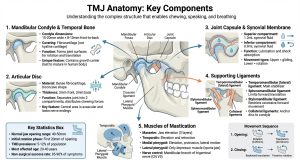
Common signs and symptoms of
TMD
TMD can present differently from person to person. Symptoms may
include:
- pain or tenderness in the chewing muscles or jaw joint
- jaw fatigue, tightness or stiffness
- pain that spreads into the cheek, temple, face or neck
- painful clicking, popping or grating
- limited opening, catching or locking
- headache associated with jaw movement or muscle
tenderness - ear-region symptoms such as ringing, a blocked sensation or
dizziness - a change in the way the upper and lower teeth meet
- tooth wear, fractures or sensitivity associated with grinding or
clenching.
Painless clicking is common and usually does not need treatment.
Painful clicking, restricted movement, locking or a change in your bite
deserves assessment. Jaw and facial pain can also come from dental
infection, sinus disease, neuralgia, headache disorders, trauma and
other causes, so self-diagnosis is unreliable.
When jaw pain needs urgent
care
Do not book a device treatment first if symptoms may be
urgent
Call triple zero (000) if jaw discomfort occurs with chest pain,
breathlessness, nausea, sweating, dizziness or pain spreading into an
arm, shoulder, neck or back. Seek urgent care for jaw symptoms with
vision changes, difficulty eating or drinking, frequent severe
headaches, a significant injury, facial weakness or numbness, marked
swelling or fever, or an inability to close or move the jaw
normally.
What causes TMD and jaw
clenching?
TMD is not one single disease with one single cause. Joint injury can
cause some disorders, but for many people the cause is unclear and
involves a mix of biological, psychological and social factors. Jaw
overuse, clenching, pain sensitivity, sleep problems, stress, trauma and
other health conditions may contribute in different combinations.
Awake bruxism and sleep bruxism are now regarded as distinct
jaw-muscle activities. Stress can increase daytime clenching for some
people, but it is not the only possible contributor. Sleep bruxism may
coexist with sleep disorders or medication effects and should not be
reduced to “just stress”. Current research also does not support the
common claim that a “bad bite” or orthodontic treatment is a usual cause
of TMD.
What is usually tried first
for TMD?
Because many TMD symptoms are temporary and evidence for many
interventions is limited, authoritative guidance recommends starting
with conservative, reversible care and avoiding procedures that
permanently change the teeth, bite or jaw joint unless a specific
diagnosis and specialist plan justify them. Depending on the cause, a
dentist, doctor or physiotherapist may discuss:
- short-term modification of hard or chewy foods during a
flare - reducing gum chewing, nail biting and sustained
clenching - heat or cold and gentle exercises recommended for the
individual - physiotherapy or manual therapy to support movement and
function - stress, sleep and habit-management strategies
- a custom dental appliance to protect teeth or support habit
reversal - medicines only when recommended by an appropriate
clinician.
A splint or night guard can help protect teeth, but it does not
automatically stop jaw-muscle activity or resolve every type of TMD
pain. If a device increases pain or changes how your teeth meet, contact
the prescribing dentist.
What is EMFACE Functional
(Jaw Relief)?
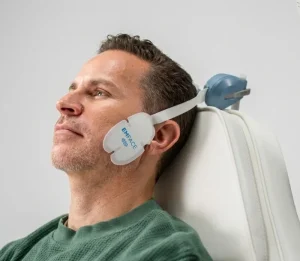
EMFACE Functional is a hands-free treatment delivered with adhesive
applicators positioned over selected facial or jaw-muscle areas. The
platform combines two synchronised energy types:
- HIFES™ electrical stimulation delivers programmed, rhythmic
contractions. BTL describes this as local muscle stimulation and muscle
re-education. - Synchronised radiofrequency (RF) produces controlled tissue
heating. The Australian intended-purpose wording includes elevating
local tissue temperature and increasing local blood
circulation.
During treatment you can expect a warm sensation and noticeable,
rhythmic muscle contractions. Intensity is adjusted to the person and
the treatment must be monitored. Pain or excessive heat should be
reported immediately.
Australian device information
EMFACE is a hands-free medical-device system used with the main
device and single-use electrodes. BTL Australia lists ARTG 394105 and
ARTG 393998 for the relevant radiofrequency applicator and
transcutaneous electrical-stimulation electrode. THIS PRODUCT IS NOT
AVAILABLE FOR PURCHASE BY THE GENERAL PUBLIC. ALWAYS FOLLOW THE
DIRECTIONS FOR USE.
How might EMFACE
fit into a jaw-tension plan?
The most defensible role is as a possible adjunct for a carefully
screened person whose symptoms appear predominantly muscular—for
example, jaw tightness, fatigue or tenderness associated with
clenching—while dental, joint, neurological and medical causes are
considered. The proposed rationale is local muscle stimulation plus
controlled warmth and circulation.
EMFACE does not:
- confirm a TMD diagnosis
- reposition a displaced disc or repair an arthritic or injured
joint - treat dental decay, infection or a fractured tooth
- protect enamel from sleep grinding in the way a dental guard
can - address every cause of bruxism, headache, ear symptoms or facial
pain - guarantee pain relief, improved movement or a permanent
result.
What does the evidence
actually say?
The evidence needs to be separated into two levels. First, a 2023
systematic review and meta-analysis of seven randomised trials involving
184 people found that electrical-stimulation modalities reduced TMD pain
more than sham stimulation. The review did not find clear benefits for
mouth opening or muscle activity. Those studies assessed modalities such
as TENS or high-voltage stimulation; they were not trials of the EMFACE
HIFES-plus-RF protocol.
Evidence for electrical stimulation in general is not proof that the EMFACE HIFES-plus-RF protocol will produce the same results. Manufacturer descriptions should be distinguished from independent, controlled clinical research. Ask the clinic to explain the current device-specific studies, their limitations and how closely the participants and protocol match your situation. A predictable degree or duration of relief cannot be promised.
Our evidence standard
We do not quote promotional response percentages as if they were
guaranteed outcomes. We explain uncertainty, screen for alternative
causes, use conservative language and recommend dental, medical or
physiotherapy assessment when it is the more appropriate next
step.
Who may
be suitable—and who needs another pathway first?
| May be considered after assessment | Needs dental, medical or urgent assessment first |
|---|---|
| Adult with persistent muscle-dominant jaw tightness, fatigue or tenderness |
Acute tooth pain, swelling, fever or suspected dental infection |
| Clenching-related symptoms without urgent warning signs | A locked, dislocated or recently injured jaw |
| Willing to combine treatment with appropriate conservative care | New neurological symptoms, vision changes or severe headaches |
| Understands the direct evidence is limited and outcomes vary | Jaw pain with chest or other possible cardiac symptoms |
| Passes device-specific screening | Electronic or metal implants, or another contraindication under the current Instructions for Use, until formally assessed |
This is not a complete contraindication list. Pregnancy, recent
procedures, skin conditions, medicines, implanted devices, dental
hardware and relevant health history must be disclosed. The current BTL
Instructions for Use and clinic screening protocol determine
suitability.
What happens
at an EMFACE jaw-tension appointment?
- Assessment: we discuss symptoms, triggers, dental history, health
conditions, implants and red flags. This is a treatment-suitability
screen, not a TMD diagnosis. - Preparation: the skin is cleansed and single-use applicators are
positioned according to the current protocol. - Treatment: a session is approximately 20 minutes. You feel warmth
and rhythmic contractions while the treatment is continuously
monitored. - Afterwards: there is no planned recovery period. Temporary
redness, warmth, muscle fatigue or soreness can occur; heat-based
treatment can cause skin injury if not delivered or monitored
appropriately. - Plan: a commonly used clinic course is four sessions, adjusted to
the individual and current BTL protocol. Maintenance is not automatic
and is discussed only after response is reviewed. - Review: progress should be based on function and symptoms—not a
promise. Useful measures include morning and evening tension, pain
during chewing, headache frequency, comfortable jaw movement and whether
daily activities feel easier.
How EMFACE
compares with other conservative options
| Approach | Potential role | Important limitation |
|---|---|---|
| Dental assessment / splint | Rule out tooth and bite-related problems; protect teeth from grinding; selected appliances may support habit reversal |
A splint does not necessarily stop bruxism or relieve every type of TMD pain |
| Physiotherapy / self-management | Improve movement and function; address habits, loading and contributing neck or postural factors |
Requires an individual plan and active participation |
| EMFACE Functional | Non-invasive local muscle stimulation and controlled warming for a suitable, muscle-dominant presentation |
Direct EMFACE/TMD evidence is early; it does not diagnose TMD or protect teeth |
| Prescription or procedural care | May be considered by an authorised clinician for selected diagnoses |
Requires medical or dental assessment; benefits and risks vary and some options are not first-line |
Frequently
asked questions about TMJ, clenching and EMFACE
What is the
difference between TMJ, TMD and TMJD?
TMJ is the temporomandibular joint itself. TMD means
temporomandibular disorders—the conditions affecting the joint, chewing
muscles or associated headache. TMJD is a commonly searched abbreviation
for TMJ disorder or dysfunction, but TMD is the more precise umbrella
term.
Is jaw clenching the same
as bruxism?
Clenching can be one form of bruxism. Bruxism can occur while awake
or asleep and can include grinding, clenching, bracing or thrusting the
jaw. It is jaw-muscle activity rather than a single diagnosis, and it is
not always harmful.
Does a clicking jaw
always need treatment?
No. Painless clicking is common and usually does not require
treatment. Clicking with pain, locking, restricted movement, trauma or a
change in the bite should be assessed.
Can TMD cause headaches?
TMD can be associated with headache, especially when pain is linked
to jaw movement or tenderness in the chewing muscles. Headaches have
many other causes, so new, severe, frequent or changing headaches need
medical assessment rather than assuming the jaw is responsible.
Can TMD cause ear
pain, ringing or dizziness?
Ear-region symptoms can occur with TMD, but infection, hearing
conditions, migraine and other causes can feel similar. Persistent
hearing loss, severe dizziness or new neurological symptoms need
appropriate medical review.
Can TMD feel like tooth pain?
Yes, pain can be referred into the teeth or face, but a damaged or
infected tooth can also mimic TMD. Dental causes should be ruled out
when tooth pain, sensitivity, swelling or pain on biting is present.
Does stress cause jaw
clenching?
Stress may increase awake clenching for some people, but it is not
the only contributor. Sleep, medicines, pain, habits and other health
factors may also matter. A useful plan addresses the individual pattern
instead of blaming stress alone.
Is teeth grinding
linked with sleep apnoea?
Sleep bruxism and sleep-disordered breathing can coexist, but
grinding does not diagnose sleep apnoea. Loud snoring, witnessed pauses
in breathing, choking during sleep or marked daytime sleepiness should
be discussed with a doctor or dentist trained in sleep health.
Who should diagnose TMD?
A dentist or doctor should assess and diagnose persistent or
concerning jaw pain. Depending on the presentation, care may involve an
orofacial pain dentist, oral and maxillofacial clinician,
physiotherapist, GP, sleep clinician, neurologist or ENT specialist.
Can EMFACE cure TMD?
No. TMD includes many different conditions, and EMFACE should not be
advertised as a cure. It may be considered as an adjunct for a suitable
muscle-dominant presentation after screening, with no guarantee of
benefit.
Can EMFACE help with jaw
clenching?
The treatment is designed to stimulate selected facial muscles and
provide controlled warming. Some people with muscle-related tension may
be suitable, but it does not remove every trigger for clenching and
direct clinical evidence remains limited.
Will EMFACE stop
grinding my teeth at night?
There is no reliable basis for promising that it will stop sleep
bruxism. If you grind at night, dental assessment may be needed to
protect the teeth and consider sleep or medication contributors.
Does EMFACE
replace a night guard or dental splint?
No. EMFACE does not cover or protect the teeth. Continue any
appliance prescribed by your dentist unless that dentist advises
otherwise, and report any appliance-related pain or bite change.
Can EMFACE
improve how far I can open my mouth?
Improved comfort may make movement feel easier for some people, but
improvement cannot be promised. Restricted opening or locking can
indicate a joint or disc problem and should be assessed before
treatment.
Can EMFACE treat a locked
jaw?
A locked or dislocated jaw is not a routine EMFACE presentation. Seek
dental or medical assessment promptly, especially after injury or if you
cannot eat, drink or close the mouth normally.
Does EMFACE jaw treatment
hurt?
Most descriptions emphasise warmth and strong rhythmic contractions
rather than pain. Treatment intensity is adjusted, and you should
immediately report pain, burning or excessive heat so treatment can be
stopped or changed.
Is there downtime after
EMFACE?
There is no planned recovery period and most people can return to
normal daily activity. Temporary redness, warmth, tenderness, fatigue or
soreness may occur. “No downtime” does not mean “no possibility of side
effects”.
How
long is a session and how many sessions will I need?
A session is approximately 20 minutes. A commonly used clinic course
is four sessions, but the plan must follow current BTL protocol,
individual screening and response. More treatment is not automatically
better.
When will
I notice a result and how long will it last?
Timing and duration vary, and the direct evidence is not strong
enough to promise a standard timeline. Progress is reviewed across a
planned course using symptoms and function; maintenance is discussed
only if there is a worthwhile response.
Will EMFACE slim
my jaw or shrink the masseter?
The functional jaw-tension protocol should not be promoted as a
guaranteed jaw-slimming or masseter-reduction treatment. Any visible
change may differ from functional change, and the treatment goal should
be agreed during assessment.
Can
I have EMFACE with braces, crowns, dental implants or metal plates?
This cannot be answered safely online. Electronic and metal implants can affect treatment safety and must be assessed under the current device Instructions for Use. All dental hardware must be disclosed and checked against the
current Instructions for Use before booking a treatment course.
Can
I have EMFACE with a pacemaker or another electronic implant?
No treatment should proceed without formal device-specific screening.
An electronic or metal implant may contraindicate treatment under the current device Instructions for Use. Tell the clinic about every implanted
device before an appointment.
Can I have
EMFACE while pregnant or breastfeeding?
Pregnancy and breastfeeding must be disclosed. Suitability is
determined under the current BTL Instructions for Use and clinic policy;
where safety data are limited, treatment is generally deferred rather
than assumed safe.
What are the risks and side
effects?
Possible short-term effects include redness, warmth, tenderness,
muscle fatigue or soreness. Because RF heats tissue, excessive heat can
cause burns or skin injury. Applicators should not be used over
unsuitable skin, scar tissue or prohibited implants, and treatment must
be monitored.
How
much does EMFACE jaw treatment cost on the Gold Coast?
Cost depends on assessment and the individual plan, so a fixed price
is not published here. You will receive a clear quote before deciding.
Ask your private health insurer directly about any possible cover;
reimbursement is not guaranteed.
Can I
combine EMFACE with dental care or physiotherapy?
Often the safest approach is coordinated rather than either-or.
EMFACE may sit alongside dental protection, physiotherapy, habit work,
sleep assessment or medical care when each has a clear role and the
treating clinicians are informed.
What happens if EMFACE
does not help?
Treatment should be reviewed rather than continued indefinitely. If
there is no meaningful improvement, symptoms change or new red flags
appear, the next step is dental or medical reassessment and a different
management plan—not stronger marketing promises.
Related: Learn more about EMFACE facial treatments on the Gold Coast.
EMFACE
jaw-tension assessment on the Gold Coast
Aesthetic Nurse Irina is a Registered Nurse working in clinical
aesthetic medicine since 2017. At your appointment, Irina will screen
whether the EMFACE Functional protocol may be suitable and recommend
dental, medical or physiotherapy review when your symptoms fall outside
the clinic’s scope. Aesthetic Nurse Irina offers EMFACE as a paid
service, so this article intentionally separates product information
from the strength of the evidence.
Appointments are available by arrangement at:
- Capri Medical Centre — Shop 4, 15 Via Roma, Isle of Capri QLD
4217 - Sibina Cosmetic Tattoo Art Clinic — 14–15 Victoria Avenue,
Broadbeach QLD 4218
Not sure whether your jaw symptoms are suitable for
EMFACE?
Read
about EMFACE TMJ treatment on the Gold Coast |
Contact the
clinic | 0468 554 770
Important information
This article is general education and does not diagnose, prevent or
treat a specific condition. Individual suitability, risks and outcomes
vary. Seek advice from a dentist or doctor for persistent, worsening or
concerning jaw pain. If symptoms may be urgent, follow the emergency
guidance above. Product information and treatment protocols can change;
current Australian device information and Instructions for Use
apply.
Reader sources
1. National Institute of Dental and Craniofacial
Research. TMD
(Temporomandibular Disorders) — overview, diagnosis and
conservative-care guidance
2. Healthdirect Australia. Temporomandibular
joint dysfunction — Australian symptom, self-care and
urgent-care guidance
3. Healthdirect Australia. Teeth grinding
(bruxism) — Australian patient information
4. National Institute of Dental and Craniofacial
Research. Bruxism
— awake and sleep bruxism information
5. Serrano-Muñoz et al., Journal of Pain (2023). Effectiveness of
Different Electrical Stimulation Modalities for Pain and Masticatory
Function in Temporomandibular Disorders — systematic review and
meta-analysis; indirect evidence, not an EMFACE trial
6. BTL Aesthetics Australia. EMFACE
Jaw Relief for providers — manufacturer product description,
Australian intended-purpose footer and safety wording; manufacturer
claims are identified as such
7. Therapeutic Goods Administration. ARTG
394105 — Class IIb monopolar radiofrequency applicator entry
8. Therapeutic Goods Administration. ARTG
393998 — Class IIb transcutaneous electrical-stimulation
electrode entry
9. Healthdirect Australia. Chest pain
— emergency guidance for chest pain with jaw or arm pain
Recents Posts
September 4, 2026

April 7, 2026


December 12, 2024
The Complete Guide to Radiesse: Your Path to Natural Facial Rejuvenation

New title
September 4, 2026
April 7, 2026
December 12, 2024
The Complete Guide to Radiesse: Your Path to Natural Facial Rejuvenation


 Online Marketing For Doctors